- Posted by : avyaay
- Software Development
In today’s fast-paced financial markets, traders rely heavily on real-time data, instant market analysis, and seamless execution tools to make informed decisions. A high-performance trading dashboard plays a critical role in delivering all of this information in a fast, reliable, and user-friendly interface. Whether it is a stock trading platform, cryptocurrency exchange, forex application, or investment management system, the dashboard is often the central component that traders interact with every day.
As trading volumes continue to increase and market conditions become more volatile, businesses must build dashboards that can process massive amounts of data while maintaining speed, stability, and security. A poorly optimized dashboard can lead to delayed information, poor user experience, and even financial losses.
This article explores the key components, technologies, and best practices involved in building a high-performance trading dashboard.
The Importance of a Trading Dashboard
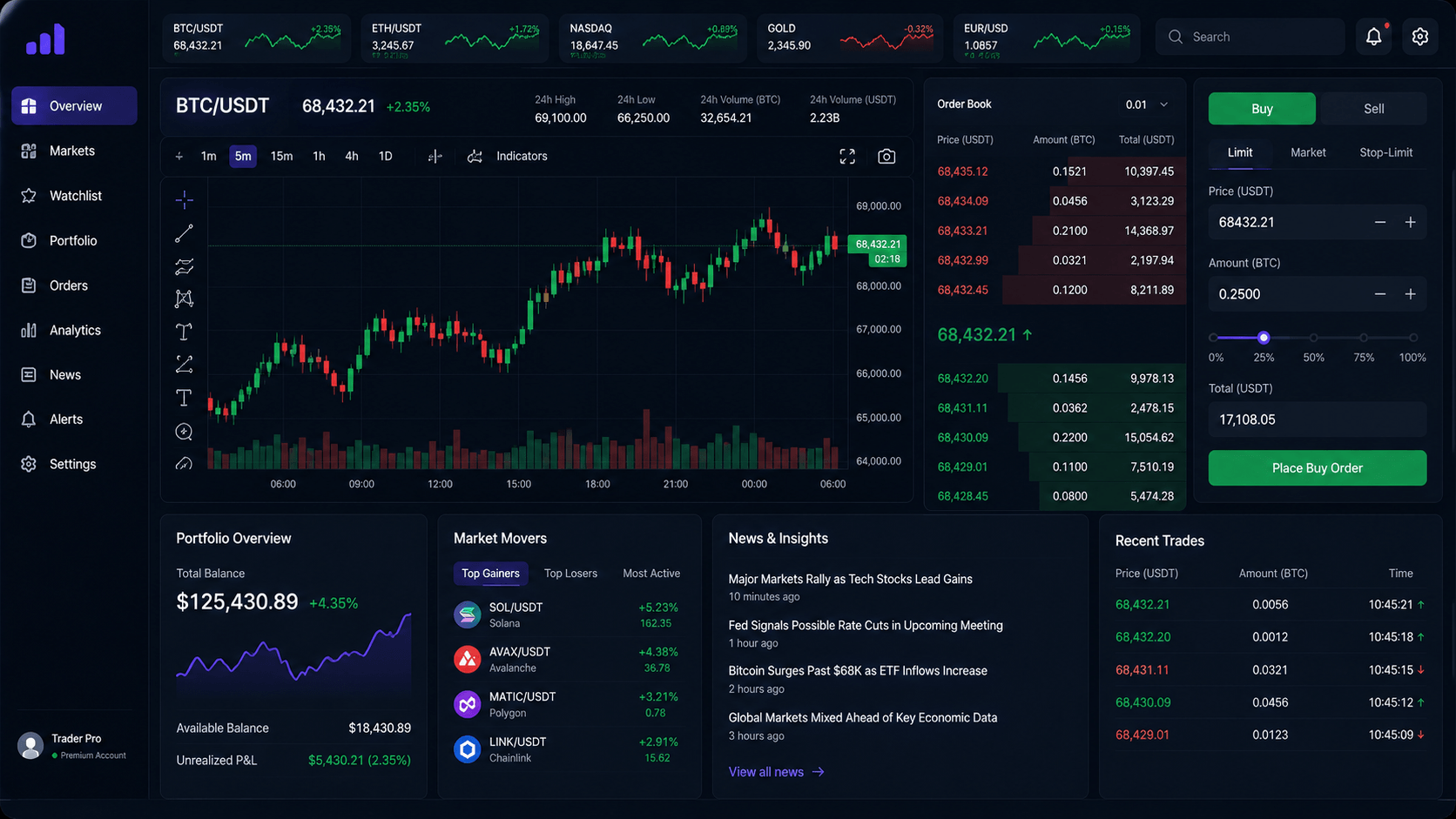
A trading dashboard is designed to provide traders with real-time market visibility and instant access to critical trading tools. It usually includes:
- Live market charts
- Order books and trade history
- Portfolio performance tracking
- Price alerts and notifications
- Technical indicators
- Risk management tools
- Real-time news feeds
- Trade execution panels
Since financial markets move within seconds, the dashboard must display accurate information with minimal latency. Traders depend on these systems to make quick decisions, which makes performance optimization extremely important.
1. Real-Time Data Processing
One of the most important features of a trading dashboard is real-time data delivery. Market prices, trade volumes, and order updates change continuously, requiring dashboards to process and display live information instantly.
Technologies such as WebSockets are commonly used to maintain continuous communication between servers and frontend applications. Unlike traditional HTTP requests, WebSockets allow real-time bidirectional data transfer, reducing delays and improving responsiveness.
Efficient data streaming infrastructure helps dashboards update charts and trading data without constant page refreshes. This creates a smooth experience for traders during high market activity.
2. Optimized User Interface Design
A high-performance trading dashboard must present large amounts of complex financial data in a clear and organized way. Traders need quick access to information without confusion or clutter.
Modern frontend frameworks such as React, Angular, and Vue.js are widely used for building interactive and responsive trading interfaces. These frameworks help developers create dynamic dashboards that can update data efficiently without reloading the entire application.
Good dashboard design focuses on:
- Fast loading speed
- Responsive layouts
- Easy navigation
- Customizable widgets
- Dark mode support
- Multi-device compatibility
User experience directly impacts trading efficiency, especially during fast-moving market conditions.
3. Low-Latency System Architecture
Latency is one of the biggest challenges in trading software development. Even small delays in data delivery or trade execution can affect profitability.
To build a high-performance dashboard, businesses must optimize backend infrastructure for speed and reliability. This includes:
- High-speed data processing systems
- Efficient caching mechanisms
- Load balancing
- Content delivery networks (CDNs)
- Distributed cloud infrastructure
Microservices architecture is also becoming popular because it allows different dashboard components to scale independently without affecting overall system performance.
4. Scalable Backend Infrastructure
Trading platforms often experience sudden traffic spikes during major market events or periods of high volatility. A scalable infrastructure ensures the dashboard remains stable even under heavy loads.
Cloud platforms such as AWS, Google Cloud, and Microsoft Azure provide scalable infrastructure solutions that help businesses manage growing user demands. Auto-scaling systems can dynamically increase server resources when trading activity rises.
Databases must also be optimized for handling real-time financial transactions and historical market data efficiently. Technologies like Redis, PostgreSQL, and time-series databases are commonly used in trading environments.
5. Data Visualization and Analytics
Financial data can be difficult to interpret without proper visualization tools. Trading dashboards must provide advanced charting systems and analytics tools that help users understand market trends quickly.
Interactive candlestick charts, technical indicators, heat maps, and AI-powered analytics are widely used in modern dashboards. Libraries such as TradingView, D3.js, and Highcharts help developers build professional financial visualization systems.
Advanced analytics tools can also improve trading decisions by identifying patterns, predicting trends, and generating automated insights.
6. Security and Access Control
Security is a critical requirement for any trading dashboard because financial applications handle sensitive user information and transactions.
High-performance dashboards should include:
- Multi-factor authentication (MFA)
- Data encryption
- Role-based access control
- API security
- Real-time threat monitoring
- Secure session management
Cybersecurity measures protect both users and businesses from fraud, unauthorized access, and data breaches.
7. Mobile and Cross-Platform Support
Modern traders expect access to financial markets from multiple devices, including desktops, tablets, and smartphones. A responsive dashboard ensures consistent performance across all platforms.
Cross-platform compatibility helps businesses reach more users while improving customer satisfaction. Progressive web applications (PWAs) and mobile trading apps are increasingly popular for delivering flexible trading experiences.
The Future of Trading Dashboards
Trading dashboards are evolving rapidly with advancements in artificial intelligence, cloud computing, and big data analytics. Future dashboards will become more intelligent, personalized, and automated.
AI-powered assistants may soon help traders analyze risks, detect opportunities, and automate trading strategies directly within the dashboard interface. Predictive analytics and machine learning models will further improve decision-making capabilities.
As technology continues to advance, businesses that invest in high-performance trading dashboards will gain a competitive advantage by delivering faster, safer, and more efficient trading experiences.
Final Thoughts
Building a high-performance trading dashboard requires a combination of real-time data processing, scalable infrastructure, low-latency architecture, advanced visualization tools, and strong security practices.
In the financial industry, speed and reliability are essential. A well-designed dashboard not only improves user experience but also helps traders make faster and more informed decisions. By leveraging modern technologies and optimized system architecture, businesses can create trading platforms capable of handling the demands of today’s highly competitive financial markets.
- 0 Comments
- fintech-development
- real-time-data
- trading-dashboard