- Posted by : avyaay
- Software Development
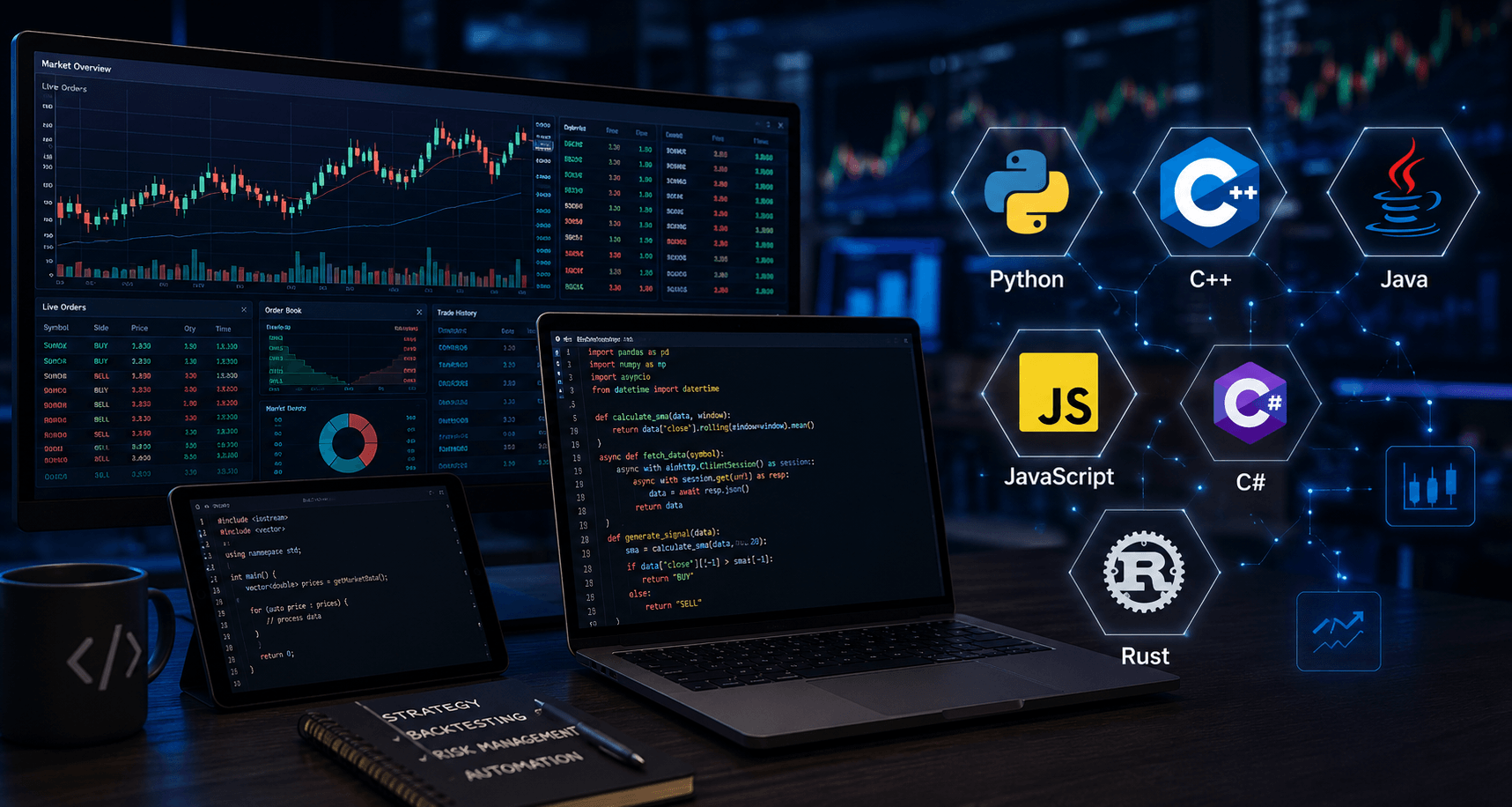
The financial trading industry has evolved rapidly over the last decade, driven by digital transformation, automation, artificial intelligence, and real-time data analysis. Modern trading platforms require high performance, low latency, advanced security, and the ability to process massive volumes of financial data in real time. Behind every successful trading application is a strong technology stack, and programming languages play a critical role in building reliable and scalable trading systems.
Choosing the right programming language for trading software development depends on several factors, including execution speed, scalability, security, data processing capabilities, and integration support. Some languages are ideal for high-frequency trading systems, while others are better suited for analytics, automation, or user interface development.
In this article, we will explore some of the best programming languages widely used in trading software development and understand why they are important in the fintech industry.
1. Python
Python is one of the most popular programming languages in the financial technology industry. It is widely used for algorithmic trading, market analysis, machine learning, and automation because of its simplicity and powerful ecosystem.
Python provides extensive libraries such as Pandas, NumPy, TensorFlow, and Scikit-learn, which help developers analyze market trends, build predictive models, and automate trading strategies. Many trading firms use Python for quantitative analysis and AI-powered trading bots.
Another major advantage of Python is its rapid development capability. Developers can quickly build prototypes, test trading algorithms, and integrate APIs with trading platforms. Although Python may not be the fastest language for ultra-low-latency trading systems, it remains an excellent choice for data-driven financial applications.
2. C++
C++ is considered one of the best programming languages for high-frequency trading (HFT) systems because of its exceptional performance and low-level memory control. Trading firms that require ultra-fast trade execution often rely on C++ to minimize latency.
In financial markets, even milliseconds can make a huge difference. C++ allows developers to build highly optimized systems capable of processing large amounts of market data with minimal delay. It is commonly used in trading engines, real-time market data systems, and risk management applications.
While C++ offers high performance, it is also more complex than modern high-level languages. Developers need advanced expertise in memory management and system optimization to build stable applications.
3. Java
Java is another widely used language in trading software development. It offers strong performance, scalability, portability, and security, making it ideal for enterprise-level trading platforms.
Many banks and financial institutions use Java because of its reliability and robust ecosystem. Java applications can run across different operating systems, which helps businesses maintain scalable infrastructure without major compatibility issues.
Java is commonly used for backend trading systems, financial transaction processing, and server-side applications. It also supports multithreading, allowing trading platforms to handle multiple processes simultaneously while maintaining system stability.
4. JavaScript
Modern trading platforms require responsive and interactive user interfaces, and JavaScript plays a major role in frontend development. Web-based trading dashboards, live market charts, and real-time notifications often rely on JavaScript frameworks such as React, Angular, or Vue.js.
JavaScript enables developers to create dynamic trading experiences that work smoothly across desktop and mobile devices. Real-time updates using WebSockets allow traders to monitor market changes instantly without refreshing the page.
Although JavaScript is not commonly used for core trading engines, it remains essential for building modern trading interfaces and improving user experience.
5. C#
C# is a popular choice for financial institutions using the Microsoft technology ecosystem. It is widely used for desktop trading applications, financial analytics tools, and enterprise trading software.
The .NET framework provides excellent support for secure and scalable application development. C# also offers strong integration capabilities with databases, cloud platforms, and third-party APIs, making it suitable for complex financial systems.
Many brokerage firms use C# to build internal trading tools and portfolio management systems due to its reliability and developer-friendly environment.
6. Rust
Rust is gaining popularity in the fintech and trading industry because of its focus on performance, memory safety, and concurrency. It provides speed comparable to C++ while reducing the risk of memory-related errors and system crashes.
As trading systems become more complex, companies are exploring Rust for building secure and high-performance financial applications. Rust is particularly useful for systems requiring both speed and stability.
Although it is still relatively new compared to established languages, Rust is expected to play a larger role in future trading infrastructure development.
Factors to Consider When Choosing a Language
Selecting the right programming language for trading software development depends on business goals and technical requirements. Important factors include:
- Performance and execution speed
- Scalability and reliability
- Security features
- Real-time data processing capability
- API and cloud integration support
- Ease of maintenance and development speed
Many modern trading platforms use multiple programming languages together to achieve the best results. For example, C++ may handle the trading engine, Python may power analytics, and JavaScript may manage the frontend dashboard.
Final Thoughts
Trading software development requires a balance between speed, scalability, security, and user experience. Programming languages such as Python, C++, Java, JavaScript, C#, and Rust each offer unique advantages depending on the specific needs of a trading platform.
As financial markets continue evolving with AI, automation, and cloud technology, the demand for advanced trading applications will continue to grow. Businesses that choose the right technology stack can build faster, safer, and more reliable trading systems capable of meeting modern market demands.
For fintech companies and IT service providers, understanding these programming languages is essential for developing competitive trading solutions in today’s rapidly changing digital economy.