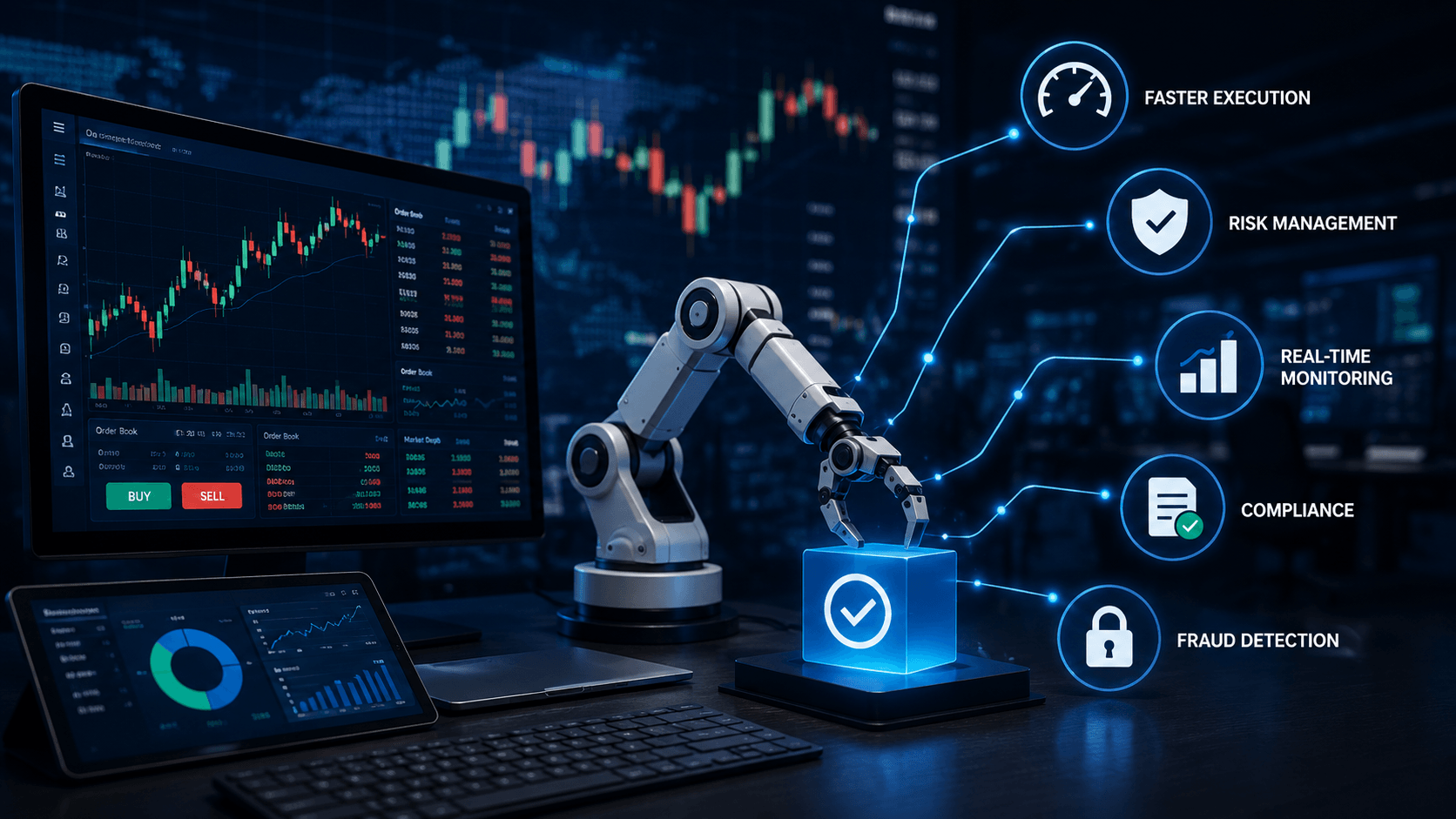
- Posted by : avyaay
- Business Technology
The financial trading industry has experienced major technological advancements over the past decade. Modern trading operations now rely heavily on automation to improve efficiency, increase speed, and reduce operational risks. From stock exchanges and forex markets to cryptocurrency platforms and investment firms, automation has become an essential part of managing complex trading environments.
Trading operations involve handling large amounts of real-time market data, executing transactions within milliseconds, monitoring market conditions, and ensuring regulatory compliance. Manual processes in such a fast-moving environment can lead to costly errors, delays, and security vulnerabilities. This is where automation plays a critical role.
By integrating automated systems into trading operations, businesses can reduce human error, improve decision-making, enhance security, and maintain consistent performance even during periods of high market volatility.
Understanding Automation in Trading
Automation in trading refers to the use of software systems, algorithms, artificial intelligence, and predefined rules to manage trading activities without constant human intervention. Automated trading systems can analyze market trends, execute trades, monitor risks, and generate reports in real time.
These systems are designed to react faster than manual traders while following strict trading strategies and compliance rules. As financial markets become more data-driven, automation helps organizations process information quickly and make more accurate decisions.
1. Reducing Human Errors
One of the biggest advantages of automation in trading operations is the reduction of human error. Manual trading processes often involve repetitive tasks such as entering trade details, calculating risks, monitoring price changes, and generating reports. Even experienced professionals can make mistakes under pressure.
A simple data entry error or delayed trade execution can result in significant financial losses. Automated systems eliminate many of these risks by following predefined instructions with precision and consistency.
For example, automated order management systems can instantly place trades based on market conditions without requiring manual approval. This reduces the chances of incorrect trade execution and improves operational reliability.
2. Faster Trade Execution
Financial markets move extremely quickly, and timing is critical for successful trading operations. Automation enables systems to execute trades within milliseconds, far faster than human traders.
High-frequency trading firms rely on automated algorithms to identify opportunities and execute large volumes of transactions in real time. Faster execution helps traders take advantage of market movements while minimizing the risk of missed opportunities.
In volatile markets, even small delays can impact profitability. Automated trading infrastructure ensures consistent execution speed and minimizes latency-related risks.
3. Improved Risk Management
Risk management is one of the most important aspects of trading operations. Automated systems can continuously monitor market conditions, portfolio exposure, and trading limits without interruption.
Modern trading platforms use automation to set stop-loss orders, manage position sizes, and detect unusual market activity. If market conditions become unfavorable, automated systems can immediately trigger protective actions to reduce losses.
Automation also helps businesses maintain disciplined trading strategies. Unlike human traders, automated systems do not make emotional decisions during market fluctuations, helping organizations avoid impulsive trading behavior.
4. Real-Time Market Monitoring
Financial markets operate continuously across different regions and time zones. Monitoring global markets manually is both difficult and inefficient.
Automated systems can analyze real-time market data 24/7, identify patterns, and send alerts when specific conditions are met. This allows trading firms to respond quickly to sudden price changes, economic news, or market disruptions.
Artificial intelligence and machine learning technologies further enhance automation by identifying hidden trends and improving predictive analysis capabilities.
5. Enhanced Compliance and Reporting
Trading operations must comply with strict financial regulations and reporting requirements. Manual compliance processes can be time-consuming and increase the risk of regulatory violations.
Automation simplifies compliance management by maintaining accurate records, monitoring trading activities, and generating reports automatically. Regulatory checks can be integrated directly into trading systems to ensure all transactions follow industry standards and legal requirements.
This reduces the risk of penalties, audit issues, and reputational damage for financial organizations.
6. Increased Operational Efficiency
Automation significantly improves operational efficiency by reducing repetitive manual tasks and streamlining workflows. Employees can focus on strategic decision-making, market analysis, and customer support instead of routine administrative activities.
Automated systems also improve scalability. Trading firms can process larger transaction volumes without needing proportional increases in staffing or operational costs.
Cloud computing, AI-driven analytics, and automated infrastructure management have made it easier for organizations to scale trading operations securely and efficiently.
7. Strengthening Cybersecurity and Fraud Detection
Cybersecurity threats remain a major concern for trading platforms and financial institutions. Automated security systems can detect suspicious activity, monitor unauthorized access attempts, and respond to threats in real time.
Fraud detection tools powered by AI can analyze transaction patterns and identify anomalies that may indicate fraudulent behavior. Automation helps organizations respond faster to potential security incidents and reduce the impact of cyberattacks.
The Future of Automated Trading Operations
As technology continues evolving, automation will become even more advanced in the financial sector. Artificial intelligence, machine learning, predictive analytics, and cloud-based infrastructure are already transforming trading operations worldwide.
Future trading systems will likely become more intelligent, capable of analyzing massive datasets and adapting to changing market conditions automatically. Businesses that adopt advanced automation technologies will gain a competitive advantage by improving speed, accuracy, and operational stability.
Final Thoughts
Automation has become a critical component of modern trading operations. By reducing human errors, improving execution speed, strengthening risk management, and enhancing compliance, automated systems help financial organizations operate more efficiently and securely.
In today’s fast-paced financial markets, businesses that invest in automation can better manage operational risks while improving performance and scalability. As the trading industry continues to evolve, automation will remain essential for building reliable, secure, and future-ready trading systems.
- 0 Comments
- fintech-technology
- risk-management
- trading-automation