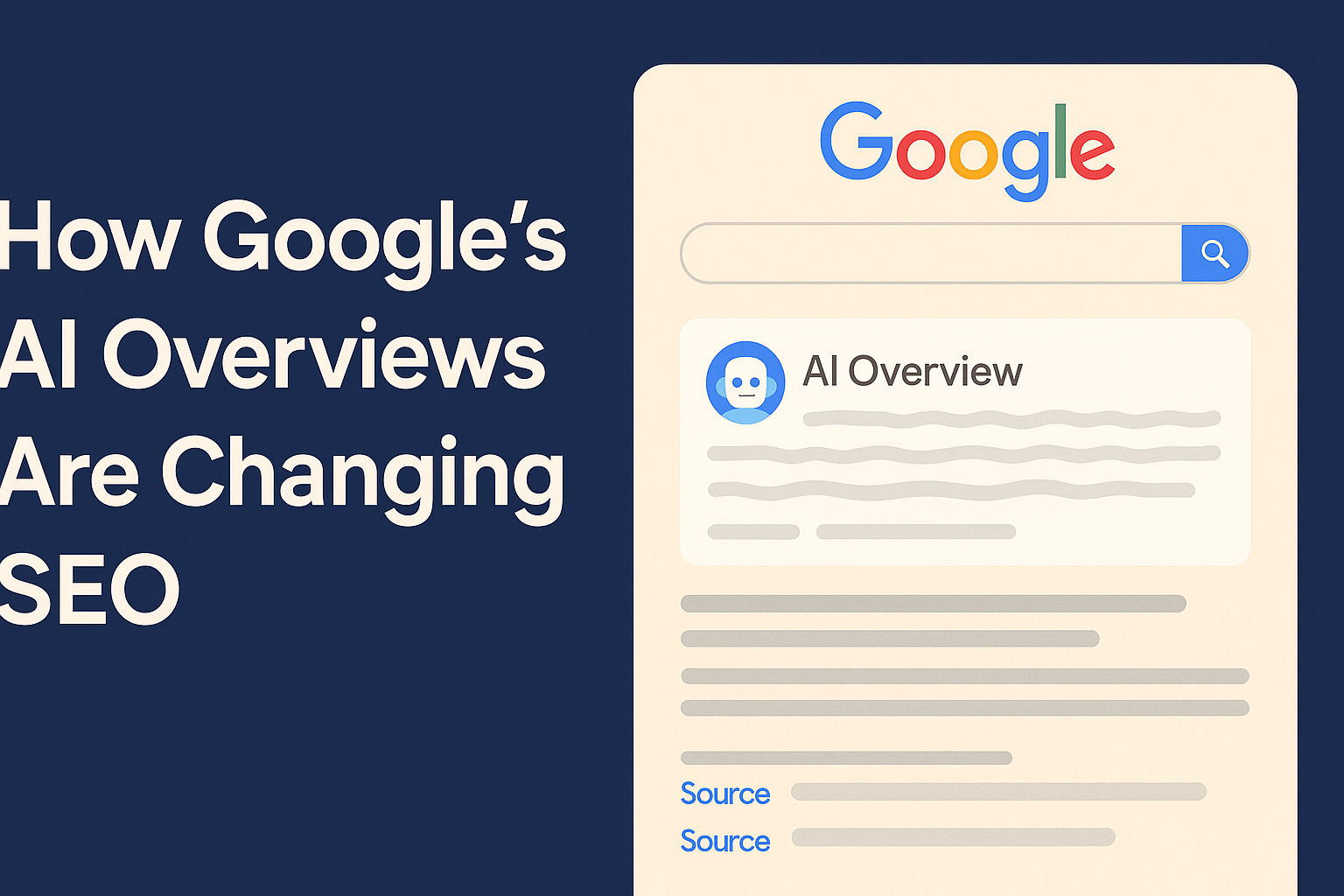
How Google’s AI Overviews Are Changing SEO
SEO is no longer just about ranking on the first page. With the rise of AI Overviews in Google Search, the way users interact with content — and how businesses earn visibility — is rapidly changing.
AI Overviews are short, AI-generated summaries that appear at the top of some search results. Instead of users clicking on websites to find answers, they’re often given an instant, concise response directly in the search interface. For everyday users, this can be helpful. But for businesses, publishers, and marketers, it introduces a new layer of competition: you’re no longer just competing with other websites — you’re competing with Google’s own AI.
What Are AI Overviews?
Google's AI Overviews are powered by large language models (LLMs) that pull data from various sources and combine it into a summary. They usually answer the user’s question directly, with citations at the bottom showing where the data came from.
Unlike traditional featured snippets, AI Overviews can combine multiple viewpoints, rephrase information, and even summarize full web pages. This changes the intent and path of the user's journey — and it means clicks may never reach your site.
How It’s Affecting Search Behavior
Early reports show that click-through rates (CTR) are dropping for queries where AI Overviews appear. Users get what they need instantly, and they often don’t scroll further.
For informational queries (like “how to optimize a Laravel app” or “what is technical SEO”), AI Overviews dominate. Users looking for quick answers or overviews no longer need to visit a page.
This impacts traditional SEO in several ways:
Less organic traffic for top-ranked pages
Higher importance on content quality, structure, and authority
More reliance on being referenced by AI, not just ranked
What Kind of Content Still Wins
Despite the disruption, SEO is far from dead. It’s just evolving. Here’s what still works — and in some cases, works better:
1. Expertise-Driven Content
AI prefers content that comes from reputable, in-depth sources. If your site consistently produces authoritative content on a niche, it’s more likely to be cited or referenced in Overviews.
2. Structured, Clear Writing
Content that’s well-organized, easy to scan, and clearly answers specific questions performs better in an AI-first SEO world. Use headings, summaries, and plain language.
3. Original Insights
AI tends to summarize the average opinion. If your content offers something unique — like case studies, first-party data, or expert commentary — it becomes more valuable, not less.
4. Semantic SEO
Rather than focusing on one keyword, write around topics and intent clusters. AI understands context, not just repetition. A well-rounded article on “Laravel performance optimization” that includes caching, database tuning, and queue handling will outperform keyword-stuffed pages.
New SEO Mindset: Optimization for Visibility, Not Just Clicks
The ultimate shift is mental: SEO is no longer just about getting a click — it’s about being part of the conversation.
If your site is referenced in an AI Overview, that's visibility — even if it's not a click.
If your brand becomes a trusted source for certain queries, that drives long-term recognition.
Think beyond traffic. Think about influence.
Final Thoughts
AI Overviews are changing the way people search, the way Google delivers answers, and the way we think about SEO. While traffic may shift or shrink, the opportunity to position your business as a trusted source of knowledge is bigger than ever.
To stay ahead, focus on authenticity, authority, and quality — because AI doesn’t just crawl your content, it interprets it.